Short Answer
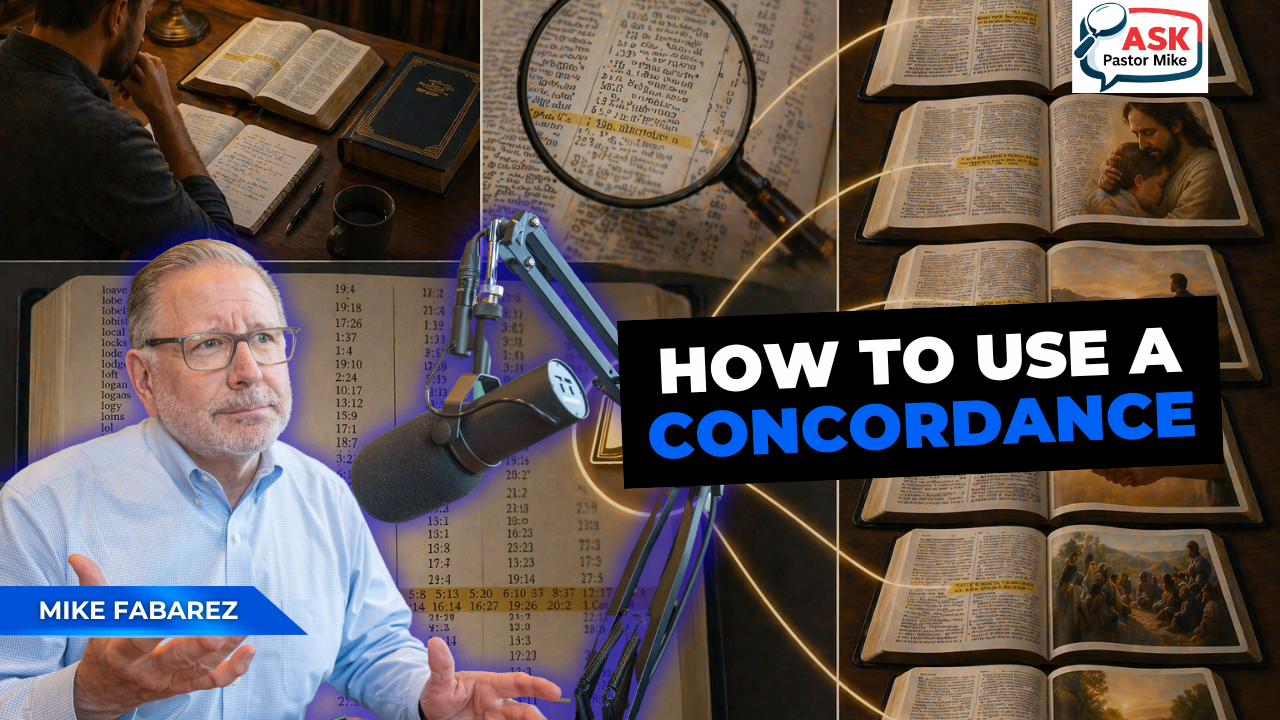
A concordance helps you find where words appear in the Bible and understand their original meanings, making it easier to study Scripture more deeply.
The Overview
A concordance is a study tool that lists every word in the Bible (in English) and shows where each word appears. This allows you to track a word—like “love” or “endurance”—across different passages and see how it is used in various contexts.
Beyond simple word searches, a concordance often connects English words to their original Greek or Hebrew terms. This is especially helpful because one English word may represent different original words, each with slightly different meanings. By exploring these, you gain a clearer and more accurate understanding of Scripture.
For example, clicking on a word in a digital concordance (like in Bible software or online tools) can show you its original language form, pronunciation, definition, and how often it appears in different books of the Bible. This helps you see patterns—such as how frequently a concept is emphasized by certain authors.
While traditional printed concordances exist, modern tools have made this process much easier. Websites and software like Bible apps allow you to instantly access concordance features with just a click, making Bible study faster and more interactive.
Ultimately, a concordance is about digging deeper—moving beyond surface reading to understand how words, themes, and meanings connect throughout Scripture.
Key Takeaways
- Find Every Word Quickly
Locate all occurrences in the Bible. - Understand Original Languages
Connect English words to Greek/Hebrew. - See Meaning Differences
One word can have multiple nuances. - Discover Patterns in Scripture
Track themes across books. - Use Digital Tools for Ease
Apps and software simplify study. - Go Deeper in Bible Study
Move beyond surface-level reading.
Bible Verse Mentioned
- John 3:16
Read Full Raw Transcript
Says. I’ve had a concordance for years, but all it’s done is sit on the on the shelf. Yes. How do I use it to help me better understand the Bible? That’s a great question, Paul. I love that question. A concordance here’s what a concordance is. It’s a weird word. A concordance is a book that is pretty much passé these days because of computers.
And even if you don’t have Bible software, which I think everyone should get some Bible software, if of course you have a computer, if you don’t have a computer, well, then you should pull your concordance out because the concordance is helpful. Concordance takes every English word and it does two things it assigns. Well, here’s the simplest thing it does in English.
It takes your English word. It lists them in alphabetical order, and it will give you every reference, every biblical reference and address for every time that English word shows up in your Bible, which is helpful if you want to see the word endurance. And you’ll find every time that it’s used in your Bible. But you’ll also assign it a number based on the Greek word, like the word hoopoe, Manet, hoopoe.
Monet is the Greek word normally translating the word endurance, but you might find in some passage maybe the word macro thema, which is another word usually translated patience that could be, in some passages translated endurance because of maybe how the sentence is working. And they’ll say, oh, that too is translated endurance in this passage. And so it’ll help you kind of understand the underlying text, and sometimes you’ll understand why it’s translated the way it is.
So it’s just going to help you get around in the Bible. But here’s the thing. Most of you have a tablet or a phone, obviously, that has the internet access. Here’s a way for you to understand what a concordance does, and it’s a lot easier than flipping pages. Even if you don’t have Bible software, which you should all get if you don’t know what Bible software to get, here’s what I recommend.
Download. Go to Log logos and download just the engine won’t cost you anything and click around on it. You can download the free versions of, you know, King James Version, I don’t know and probably get the NIV. I don’t know what else it’ll give you for free, but get all you can get for free. And it’ll certainly have a concordance for free.
And you can click around on all of these things, and it’ll do it automatically at a touch of a, of a of a of a mouse button. And that’ll be easy to start to understand how you can do some concordance work. Or another way to do this is to go to the blue letter Bible. Blue letter Bible you can start with I would go to the New American Standard.
And if you pull up the new American standard, let me just do this with you real quick and this will help you. Blue letter Bible, let me get this pulled up. If you go to the NASA 95 and then you click on the thing, the little button that says Strong’s, which is a concordance, a strong second accordance. Every word will have a number next to it.
I don’t need to explain this, but it’ll have a G and then a number, which is the kind of concordance number because they had to change the numbers. I want to explain all that, but later they had to add the G because they had to renumber them because of a few words they left out when they first did, when Strong’s first did this, but blah blah blah blah.
But like I pulled up John 316 For God so loved the world. Okay, well, next to the word love, there is a G25. If I click on G25, right, it’ll take me to the Greek word Strong’s Greek word Agapito. Agapito right is going to is going to spell it out with the English letters. Then it’s going to give me the Greek letters, which, if you don’t know Greek, it’ll just look like Greek.
It’s all Greek to me. It will then give you the transliteration, which is great because that’s in English. It’ll give you a pronunciation, and even the letter Bible will give you a little speaker there. You click on it and it’ll pronounce it for you, and then it’ll give you some etymology like, what’s the root of it? It’ll tell you how many times it shows up in the New Testament.
It’ll give you a little dictionary form from one of the oldest and common Bible dictionaries, the Vine Expository Dictionary, which is a great resource, and it will go and tell you how many times it’s translated in certain ways, like it’s translated 135 times into the word love. In the New Testament, it’s translated seven times into the word beloved in the New Testament.
And it goes on to explain all that it explains, which is a lot of different things, a lot of different ways that it’s translated in different forms in the New Testament. Anyway, that’s all that in a concordance does. It just does it a lot easier by the click of a mouse here, which is great. And you can search by book eight times in the book of Matthew, five times in the book of Mark, 13 times in the book of Luke, 37 times in the book of John.
Which is interesting, right? You say, wow, he’s really the apostle that Jesus loved uses the word love. Agapito 37 times, eight times in the book of Romans, two times the book of First Corinthians, anyway. And by the way, first John 28 times in the little book of first John. So a great way to use it. Blue Letter Bible if you don’t have any Bible software, it’s got a lot of cool things.
You can check it all out. Better yet, invest a little money in Bible software. I like logos because it’s got the most resources available. But anyway, that’s what a concordance is, Paula, and hopefully that’ll help you.



The Bible Can Inform Our Everyday Decisions...
Get Biblical clarity on complex questions that can weigh on your heart and mind. "Biblical Answers to 12 Challenging Questions" is a free resource specially designed for Christians looking to the Bible to direct their lives. This guide provides insightful answers to pressing questions that you may have. Taken from interviews with Pastor Mike Fabarez, this resource addresses thought-provoking topics such as:
- Is it Okay for Christians to Get Cremated?
- Do I Need to be Baptized to be Saved?
- Do Good People Go to Hell?
- Are Tattoos Biblical?
- And more!
To receive your FREE 65-page copy of Biblical Answers to 12 Challenging Questions by Pastor Mike Fabarez, please fill in your information in the form below to receive a download link.
Contact Permission
By clicking the "Download" button above, I am requesting to receive e-mail communications from Focal Point Ministries, and I agree to allow my personal data to be processed according to their Internet Privacy Policy.
By optionally entering my mobile number above, I also agree to receive automated text messages from Focal Point Ministries.